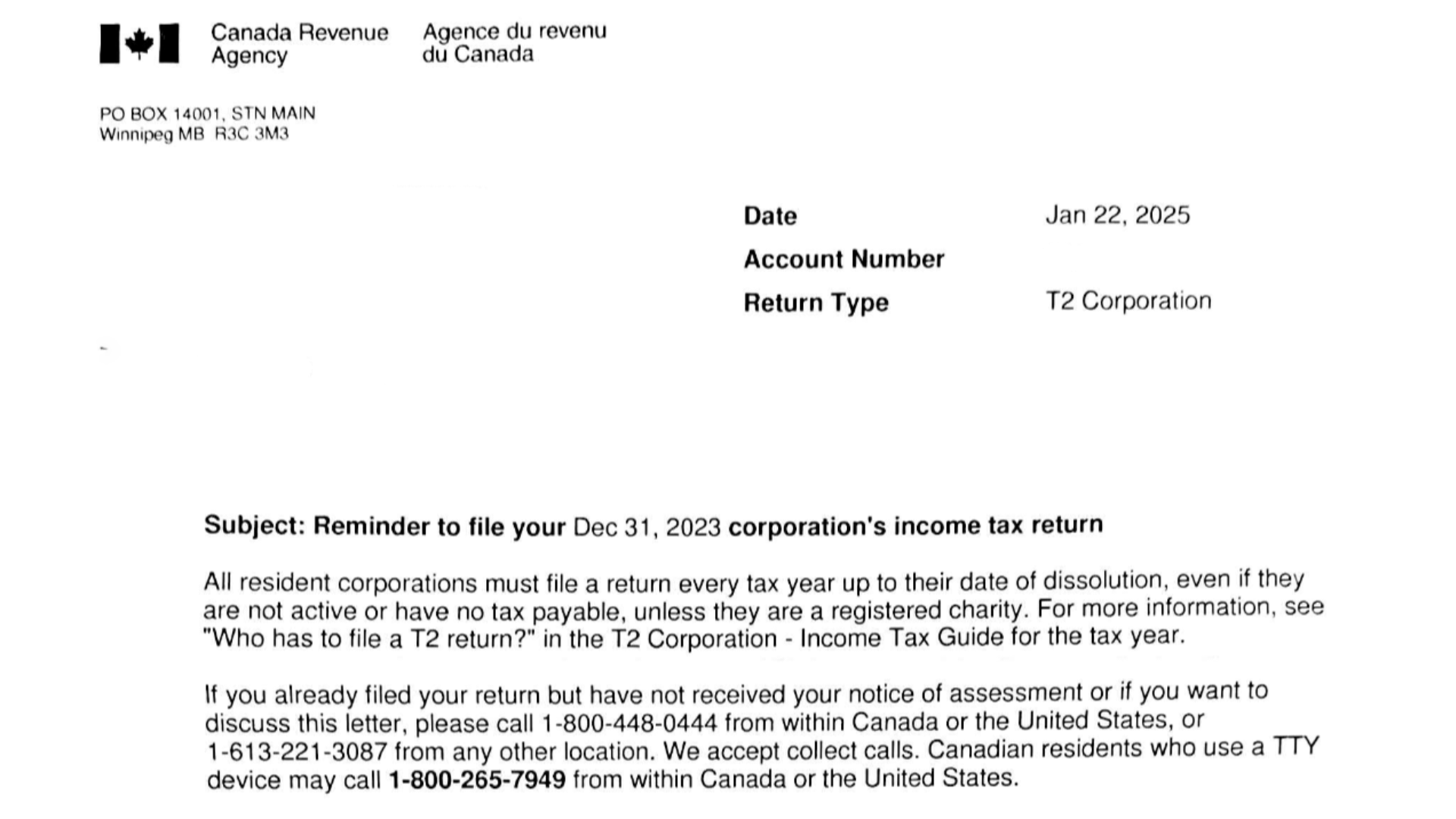
File Taxes Late: Canada Corporate Penalties
You meant to file, then you had payroll, a client fire drill, and suddenly you file taxes late and the calendar looks like it sprinted. For incorporated business owners, that slip turns into a real admin problem fast: corporate tax returns stack up, CRA mail keeps coming, and the company records start to feel out of order. This article walks through Filing Corporate Taxes Late in Canada: Penalties Explained in plain language, so you can see what CRA actually charges, what triggers the bigger headaches, and how people usually bring things back up to date.
If you are running a corporation, this stuff tends to hit when you are already busy, because corporate filings do not care about your project timeline, your staff changes, or that week you had the flu. You might have one missing T2 return, or three years of them, and you might not even know what CRA has on file until you log in and start clicking around. There is a way forward, and it usually starts with getting clear on what is late, what is owing, and what CRA is waiting for.
Once you understand the moving parts, the next steps get less mysterious, even if they are still annoying, and you can decide whether you are handling it yourself, looping in an accountant, or getting help with corporate cleanup and CRA communication.
TL;DR: The late-filing situation, decoded
- The challenge: Corporate tax returns (T2) and tax payments can fall behind, then CRA penalties and interest start to pile up.
- Why it matters: Late filing can lead to fines, interest, blocked refunds, compliance stress, and CRA follow-ups that keep interrupting work.
- Common gaps: Confusing “late filing” with “late payment,” assuming a nil return means no consequences, or thinking you can ignore old years because the business is dormant.
- A clearer way to think about it: Separate filing deadlines from payment deadlines, then map what CRA is missing, what is assessed, and what is still unknown.
- Practical paths: Confirm which years are outstanding, estimate exposure to penalties and interest, file the returns, deal with balances, and use CRA options like payment arrangements or voluntary disclosures when they fit.
When you file taxes late, what CRA actually charges
Late filing is not just a scolding letter, it has math attached to it. For corporations, the usual CRA late-filing penalty for a T2 return is 5 percent of the unpaid Part I tax, plus 1 percent of the unpaid tax for each full month the return is late, up to 12 months. If CRA has charged you a late-filing penalty in one of the prior three tax years, the repeat penalty can jump to 10 percent plus 2 percent per month, up to 20 months, so the second time hurts more.
Interest is its own track, and it keeps running. CRA charges compound daily interest on unpaid tax amounts, and that interest can apply to penalties too, which is a bit like dropping a handful of paperclips into your pocket and later wondering why you are annoyed all day. One short sentence that matters: interest does not wait.
Filing corporate taxes late in Canada: Penalties Explained, but with deadlines
Here is where people get tripped up, because “filing” and “paying” do not share the same due date. A T2 corporate return is due six months after the corporation’s fiscal year end, while any balance owing is generally due two or three months after year end depending on the corporation type, including whether it is a Canadian-controlled private corporation that qualifies for the shorter deadline. That gap is why a business can be “on time” with filing and still owe interest, or “late” on filing even if it already paid.
If you are trying to file taxes late and make it stop getting worse, start by writing down three dates for each year: fiscal year end, payment due date, and filing due date, then compare that to what CRA shows as received and assessed. It sounds basic, yet in real life it is the difference between guessing and knowing, and it keeps you from solving the wrong problem first. A lot of corporate cleanup work is just building that timeline, then moving through it in order.
The messy middle: CRA mail, accounts, and Calgary reality
CRA does not need drama to take action. A corporation that stays non-compliant can run into things like denied refunds, delays in processing, more frequent requests for information, and collections steps if balances go unpaid, and the longer it goes the more you end up managing your tax situation by reacting to letters. That eats time.
In Calgary, this often shows up in a familiar way: you are juggling GST/HST, payroll remittances, and corporate tax all at once, you just finished a week of driving Deerfoot in construction traffic, and you open the mail to find another CRA notice with a date that already passed. It is not a moral failing, it is a system that punishes disorganization, and being incorporated means the company has filing obligations even if business slowed down. One short line: CRA likes paperwork.
A practical timeline to get current, without guessing
If you are staring at a backlog, you do not need a heroic all-nighter, you need sequence. Most cleanups follow a pattern: confirm what years are missing, collect the records that support each year, prepare and file the T2 returns, then deal with assessments, balances, and any CRA conversations that follow. That order matters because CRA penalties and interest depend on what is assessed as owing, and you cannot negotiate with a number that does not exist yet.
Here is a simple planning table that matches how this usually goes when you file taxes late and want your footing back:
| Step | What you do | What you get |
|---|---|---|
| 1. Confirm status | Check CRA account and prior filings, list missing years | A clear backlog list |
| 2. Gather records | Bank statements, bookkeeping, receipts, T4/T5 slips, GST/HST info | Inputs for each year |
| 3. Prepare T2s | Build financial statements and schedules per year | File-ready returns |
| 4. File and track | Submit returns, confirm CRA received them | Proof and processing timeline |
| 5. Respond to CRA | Review notices of assessment, address questions | Final assessed balances |
| 6. Settle balances | Pay, set a payment arrangement, or explore relief options | Reduced pressure and fewer surprises |
That is the calm version of the story. The real version might include missing books, an old fiscal year end nobody remembers, or a corporation that has been inactive but not dissolved, plus that one shoebox of receipts beside the coffee grinder that somehow became “a system.”
Options when you cannot pay everything today
Sometimes the problem is not the filing, it is the money. CRA interest keeps accruing on unpaid amounts, so filing sooner can still help because it stops late-filing penalties from growing, even if you are setting up a payment arrangement for the balance. Payment arrangements are case-by-case, and CRA usually expects you to stay current going forward while paying arrears, which is hard if you keep filing behind.
For some situations, the Voluntary Disclosures Program can matter, especially when you have to correct past information or report something that was missed, though eligibility depends on meeting CRA conditions and timing before CRA contacts you about it. This is where a bit of support can save time, because you do not want to send CRA a partial story and then spend weeks clarifying it. Filing Corporate Taxes Late in Canada: Penalties Explained is really about choices, and the best choice is the one that reduces future damage while you fix the past.
Key Takeaways: The “late” part is fixable
- If you file taxes late, CRA can charge a late-filing penalty based on unpaid tax, and it can rise if you have recent prior penalties.
- Corporate filing and payment deadlines differ, so you can be late on one and not the other.
- Interest compounds daily on unpaid amounts, and it can apply to penalties too.
- The cleanest fix is a timeline: confirm missing years, gather records, file T2s, then deal with assessments and balances.
- If cash is tight, filing still matters, and CRA payment arrangements can be part of the plan.
- Filing Corporate Taxes Late in Canada: Penalties Explained gets easier once you separate facts from guesses and move year by year.
If you are sitting in Calgary with a stack of unopened CRA mail, or you just found out last year’s T2 never got filed, you are not the first person to end up here. The path out usually looks boring on paper, but boring is useful when your brain is already full, and each filed return reduces uncertainty. Handle the oldest years first if CRA is missing them, keep notes of what you submit and when, and do not ignore new deadlines while fixing old ones. If you want help getting your corporation current, dealing with CRA communication, and keeping annual compliance from sliding again, you can contact Corporate Cleanup through their Contact Us page at https://corporatecleanup.ca/contact/.