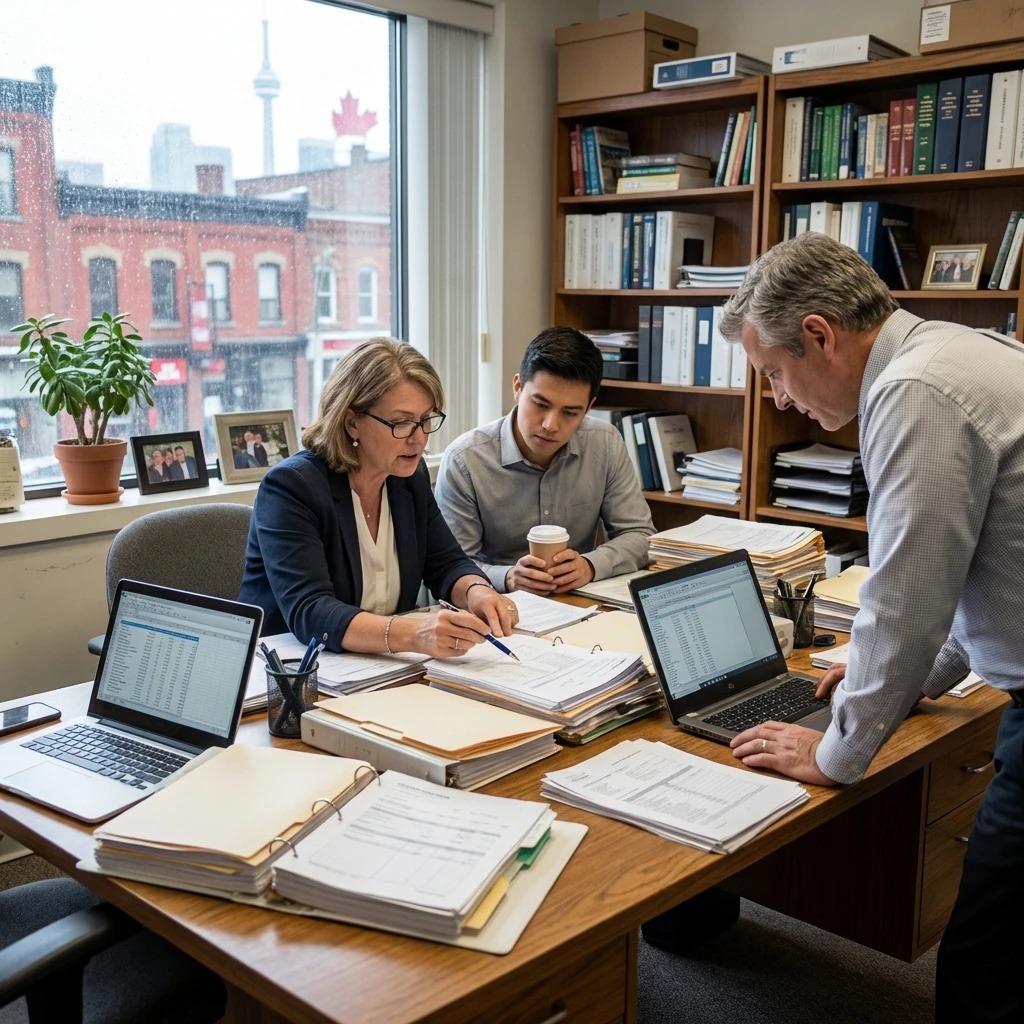
Corporate Tax Return Canada Fees Explained
Somewhere between invoicing clients and chasing receipts, the phrase corporate tax return canada starts showing up in your life like an overdue sticky note you keep moving to a new spot. If you run an incorporated company, you have a T2 corporate income tax return to file with the CRA every year, even when the company did nothing, and the fees for getting that done can swing around depending on what shape your books are in, how many years are behind, and whether the CRA is already sending mail. This piece walks through what drives the price, what you can control, and how a “cleanup” approach usually works when things got messy.
If you are already feeling that tension, you are not alone. You might have a stack of bank statements, a QBO file that is half set up, payroll that happened for a while then stopped, and a CRA inbox that keeps asking for one more thing, then another, then another, all while you are still trying to run the business and keep money coming in. There is a real difference between “file a return” and “bring a corporation back into compliance,” and that difference is where the fee confusion lives.
So, instead of guessing, it helps to look at corporate tax fees the way accountants and corporate tax services actually price them: based on time, risk, and how much reconstruction has to happen before anyone can even start the T2.
TL;DR, Because You Have Stuff To Do
- The challenge: corporate tax filing fees vary because the work varies, and many incorporated owners only see the final quote, not the moving parts behind it.
- Why it matters: late filing penalties, delays getting financing, CRA follow-ups, and stress pile up when the company is not current.
- The common gaps: assuming a T2 is “just a form,” mixing up bookkeeping cost with tax prep cost, and underestimating how much multi-year catch-up changes the scope.
- Clearer way to think about it: price follows complexity, record quality, number of filings, and how much CRA communication is involved.
- Practical paths: get your books organized, confirm what years are due, separate cleanup from annual routine, and decide whether you need ongoing support or a one-time fix.
1) Why Corporate Tax Return Canada Fees Swing
The fee range makes sense once you see what is being priced. A basic T2 for a small corporation with clean bookkeeping, a simple chart of accounts, and no weird transactions takes less time to prepare and review, while a return with shareholder loans, missing invoices, vehicle and home office allocations, or multiple revenue streams takes more back-and-forth, more questions, and more checking. Time drives cost. So does risk.
Here is the other part people miss: corporate tax work often includes steps that are not “tax” in the way you mean it, like mapping bookkeeping accounts to tax schedules, confirming GST/HST filing status, and making sure the balance sheet even ties out, and that bundle can feel like paying twice if you expected the books to already be usable. Think of it like trying to cook dinner with a recipe, then realizing your pantry is a box of mixed screws and spare keys, you can still get fed, but you are going to spend time sorting before anything tastes like food. One short truth. Messy inputs cost money.
2) The Stuff That Changes Your Quote Fast
You can almost predict the quote by walking through a few levers. The number of transactions matters, the number of bank and credit card accounts matters, the bookkeeping system matters, and the year-end financial statements matter because many T2s rely on those statements being right, not just “good enough.” If your corporation paid you dividends, salary, or both, or you moved money in and out without tracking it, the shareholder loan section can take time to untangle, and that time ends up in the bill.
Being behind changes everything. If you need three years of T2s, plus three years of bookkeeping cleanup, plus responses to CRA requests, you are not buying one tax return, you are buying a catch-up project with deadlines and consequences, and that is why corporate tax return canada pricing online can feel disconnected from real life. Calgary detail that shows up a lot: incorporated contractors in oil and gas or construction sometimes have T4A slips, subcontractors, tool and truck expenses, and job travel, and those categories are fine, but only when they are tracked like they happened on purpose. A simple habit helps. Keep business spending in business accounts.
3) Corporate Tax Return Canada Fees: Common Pricing Models
Most firms use one of a few pricing approaches, and each has tradeoffs. Some quote a flat fee for a “basic” corporate return, then add for extras, some bill hourly, and some offer a fixed project fee after a review of your records, which is common for multi-year catch-up or corporate cleanup work. If you are comparing quotes, compare scope, not just the number at the bottom, because one quote might include year-end adjusting entries and CRA follow-up, while another quote might only cover the T2 form prep if you deliver final financials.
Here is a simple way to frame it when you are shopping around in Canada, including here in Calgary.
| What is being priced | What it usually includes | What can add cost |
|---|---|---|
| T2 preparation | T2 schedules, review, filing | Extra schedules, complex balance sheet items |
| Year-end financials | Adjusting entries, financial statements used for T2 | Bad bookkeeping, missing support, multiple accounts |
| Bookkeeping cleanup | Categorizing, reconciling, fixing prior errors | High transaction volume, missing months, cash handling |
| Catch-up filings | Multiple years of T2s and related work | CRA deadlines, incomplete prior-year data |
| CRA communication | Responding to letters, requests, account review | Audit support, repeated requests, unclear records |
One more short truth. Scope wins.
4) The “Cleanup” Path vs. The “Annual Routine” Path
If you are current, life is simpler. You keep bookkeeping up to date, reconcile monthly, file GST/HST on time, run payroll properly if you have it, then your year-end work becomes a repeatable routine, and fees tend to stay stable because surprises do not show up as often. That is the version people imagine when they hear corporate tax return canada and think, “How hard can it be?”
If you are behind, you need a different plan. Corporate Cleanup style work usually starts by confirming which years are due, what the CRA account shows, what records exist, and what needs rebuilding, then prioritizing filings so penalties and interest stop stacking, and that sequence matters because you do not want to spend hours perfecting Year Three if Year One is blocking everything. Calgary life note: when Stampede week hits, lots of folks mentally clock out, and CRA deadlines do not care, so scheduling earlier than you think saves you from that mid-July scramble. Also, someone, somewhere, will hand over receipts in a crumpled shoe box that smells like winter windshield washer fluid. It happens.
5) Paying Less Without Playing Games
You cannot “hack” tax prep, but you can make it cheaper in normal ways. Clean books reduce time, and time is what you pay for, so using one business bank account, keeping receipts organized, and reconciling monthly can knock down the hours needed at year-end, and it also makes CRA questions easier to answer because you can point to support fast. If you use accounting software, keep it consistent, and if you change systems, move data carefully so the new year does not start with a broken opening balance sheet.
If you are behind, the best cost control is clarity. Get a list of missing filings, confirm whether GST/HST and payroll accounts are involved, gather bank statements for each year, and be ready to explain any personal use items, shareholder draws, or loans, because those are common sticking points in corporate files. Another short truth. Preparation pays.
Corporate Tax Return Canada Key Takeaways, Minus The Headache
- corporate tax return canada fees depend on complexity, record quality, and how many years need filing.
- A T2 is required every year for a corporation, even in inactive years, and being late can create penalties and CRA follow-up.
- Bookkeeping cleanup and tax prep often blend together because the T2 relies on accurate year-end numbers.
- Compare quotes by scope: financials, adjusting entries, filing, catch-up years, and CRA communication.
- If you are behind, treat it like a project with sequencing, not a single form to submit.
If you are trying to budget for this, focus on what you can see and control: the state of your books, the number of open years, and how fast you can gather records, then ask for pricing that matches that reality instead of a fantasy version where everything is tidy. Costs usually feel more reasonable when you understand what work is included, what risks the preparer is holding, and what you are handing over as inputs. Once you get current, the ongoing annual cycle gets more predictable, and that predictability is often what owners want most. corporate tax return canada work does not have to sit in your head all year. If you want help sorting out filings, CRA letters, and a plan to get up to date, you can Contact Corporate Cleanup and talk through the situation.